Showing posts with label classic. Show all posts

Thursday, March 14, 2013

Screenwriter of the Month: Sidney Howard

Sidney Howard.
Picture found here.
A Short Biography:

Sidney Howard was born in Oakland, California, the son of Helen Louise (née Coe) and John Lawrence Howard. He graduated from theUniversity of California, Berkeley in 1915 and went on to Harvard University to study the art of playwriting under George Pierce Baker in his "47 workshop." Along with other students of Harvard professor A. Piatt Andrew, Sidney Howard volunteered with Andrew's American Field Service, serving in France and the Balkans during World War I. After the War, Howard, competent at foreign languages, translated a number of literary works from French, Spanish, Hungarian and German.

In 1921, Howard had his first Broadway production, with a neo-romantic verse drama, Swords, which failed to win approval from either audiences or critics. It was with his realistic romance, They Knew What They Wanted in 1924 that Howard found recognition. The story of a middle-aged Italian vineyard owner who woos a young woman by mail with a false snapshot of himself, married her, and then forgives her when she becomes pregnant by one of his farm hands, it was praised for its non-judgmental and unmelodramatic view of adultery, and its warm-hearted, tolerant view of all its characters. The play won the 1925 Pulitzer Prize for Drama, was thrice adapted into film (1928, 1930, and 1940) and later became the Broadway musical, The Most Happy Fella. Lucky Sam McCarver, a coolly observed, unsentimental account of the marriage of a New York speakeasy owner on his way up in the world with a self-destructive socialite on her way down, failed to attract audiences but won the admiration of some reviewers. The Silver Cord, a drama about a mother who is pathologically close to her sons and works to undermine their romances, was one of the most successful plays of the 1926-27 Broadway season.

Picture found here.
A prolific writer, and a founding member of the Playwrights' Company, he wrote or created more than seventy plays; he also directed and produced a number of works. In 1922 he married actress Clare Eames (1896–1930) who had played the female lead in Swords. She later starred in Howard's Lucky Sam McCarver (1925), and Ned McCobb's Daughter (1926) on Broadway, and The Silver Cord in London (1927). Clare Eames was the niece of opera singer Emma Eames on her father's side, and of the inventor Hiram Percy Maxim on her mother's side, and a granddaughter of former Maryland governor, William Thomas Hamilton. Howard and Eames had a daughter, Jennifer Howard. They separated in 1927, and Howard's anger and frustration at the disintegration of his marriage is reflected in his bitter satire of modern matrimony, Half Gods (1929). Following the unexpected death of Eames in 1930, Sidney Howard married Leopoldine (Polly) Damrosch, daughter of the conductor Walter Johannes Damrosch in 1931, with whom he had three children.

A particular admirer of the understated realism of French playwright Charles Vildrac, Howard adapted two of his plays into English, under the titles, S. S. Tenacity (1929) and Michael Auclair (1932). One of his greatest successes on Broadway was an adaptation of a French comedy by Rene Fauchois, The Late Christopher Bean. Yellow Jack, an historical drama about the war against yellow fever, was praised for its high purpose and innovative staging when it premiered in 1934.

Picture found here.
Hired by Samuel Goldwyn, Howard worked in Hollywood, writing several successful screenplays. In 1932, Howard was nominated for an Academy Award for his adaptation of the Sinclair Lewis novel Arrowsmith, and again in 1936 for Dodsworth, which he had adapted for the stage in 1934.

Howard wrote the stage adaption of Humphrey Cobb's novel Paths of Glory which played on Broadway in 1935. The play was a flop because of its harsh anti-war scenes that alienated the audience, as a World War I veteran Howard wanted to show the horrors of war. Convinced that the novel should be filmed, Howard wrote, “It seems to me that our motion picture industry must feel something of a sacred obligation to make the picture.” The film version of the novel directed by Stanley Kubrick did not appear until 1957. Howard's screenplay for Gone with the Wind echoed, perhaps, Paths of Glory, with an unflinching look at the horrors of war.

Posthumously, he won the 1939 Academy Award for Writing Adapted Screenplay for Gone with the Wind (he was the only one honored, despite the fact that his script was revised by several other writers). This was the first time a posthumous nominee for any Oscar won the award.

Picture found here.
A lover of the quiet rural life, Sidney Howard died in Tyringham, Massachusetts while working on his 700-acre (2.8 km2) hobby farm. Howard was crushed to death in a garage by his two and one half ton tractor. He had turned the ignition switch on and was cranking the engine to start it when it lurched forward, pinning him against the wall of the garage. Apparently an employee had left the transmission in high gear.

He is buried in the Tyringham Cemetery.

Howard left behind a number of unproduced works. Lute Song, an adaptation of an old Chinese play co-written with Will Irwin, premiered on Broadway in 1946. A lighthearted reworking of the Faust legend, Madam, Will You Walk?, closed out of town when produced by the Playwrights Company in 1939, but was more warmly received as the first production of the Phoenix Theatre in 1953.

His Best Known & Awarded Movies:

"A Lady to Love"
movie poster.
Picture found here.
- "A Lady to Love" (1930) - Based upon Howard's play, They Knew What They Wanted, "A Lady to Love" is about a "middle-aged Napa Valley grape-grower Tony (Edward G. Robinson) posts a marriage proposal to San Francisco waitress Lena (Vilma Banky) enclosing a photo of his handsome younger brother Buck (Robert Ames). When she gets there she overlooks his duplicity and marries him. Then she falls in love with Buck." Written by Ed Stephan (Source here.)

"Arrowsmith"
movie poster.
Picture found here.
- "Arrowsmith" (1931) - Starring Ronald Colman and Helen Hayes, and "based on a Sinclair Lewis novel Martin Arrowsmith. A medical researcher is sent to a plague outbreak, where he has to decide priorities for the use of a vaccine." Written by Anonymous (Source here.)
- Nominated for a 1932 Oscar for 
"Best Writing, Adaptation"

"The Silver Cord"
movie poster.
Picture found here.
- "The Silver Cord" (1933) - Based on Howard's play of the same name, "The Silver Cord" is about "a domineering matriarch (Irene Dunne) is less than happy when her son (Joel McCrea) brings home his new bride (Laura Hope Crews). She immediately sets to work at sabotaging their marriage as well as the engagement of her younger and weaker son (Eric Linden)." Written by Daniel Bubbeo (Source here.)

"Dodsworth"
movie poster.
Picture found here.
- "Dodsworth" (1936) - Based on a Sinclair Lewis novel, it's about "[the] bittersweet tale of the increasing estrangement of a retired automobile tycoon (Walter Huston) and his wife (Ruth Chatterton). Increasingly obsessed with maintaining an appearance of youth, she falls in with a crowd of frivolous socialites during their 'second honeymoon' European vacation. He, in turn, meets a woman (Mary Astor) who is everything she is not; self-assured, self-confident, and able to take care of herself." Written by Sonya Roberts (Source here.)
- Nominated for an Oscar in 1937 for 
"Best Writing, Screenplay"

"Raffles" movie poster.
Picture found here.
- "Raffles" (1939) - "Man about town and First Class cricketer A.J. Raffles (David Niven) keeps himself solvent with daring robberies. Meeting Gwen (Olivia de Havilland) from his schooldays and falling in love all over again, he spends the weekend with her parents, Lord and Lady Melrose. A necklace presents an irresistible temptation, but also in attendance is Scotland Yard's finest, finally on the trail." Written by Jeremy Perkins (Source here.)

"Gone with the Wind"
movie poster.
Picture found here.
- "Gone With the Wind" (1939) - "This tale of the Old South from the start of the Civil War through to the period of reconstruction focuses on the beautiful Scarlett O'Hara (Vivien Leigh). Before the start of the war life at the O'Hara plantation, Tara, could only be described as genteel. As for the young Scarlett, she is without doubt the most beautiful girl in the area and is always the belle of the ball. She is very much looking forward to a barbecue at the nearby Wilkes plantation as she will get to see the man she loves, Ashley Wilkes (Leslie Howard). She is more than a little dismayed when she hears that he is to marry his cousin Melanie Hamilton (Olivia de Havilland) and in a fit of anger, she decides to marry Melanie's brother. War is soon declared and as always seems to be the case, men march off to battle thinking that it will only last a few weeks. Now living in Atlanta, Scarlett sees the ravages that war brings. She also becomes re-acquainted with Rhett Butler (Clark Gable), whom she had first met at the Wilkes barbecue. Now a widow, she still pines for the married Ashley and dreams of his return. With the war lost however, she returns to Tara and faces the hardship of keeping her family together and Tara from being sold at auction to collect the taxes. She has becomes hardened and bitter and will do anything, including marrying her sister's beau, to ensure she will never again be poor and hungry. After becoming a widow for the second time, she finally marries the dashing Rhett but they soon find themselves working at cross-purposes, their relationship seemingly doomed from the outset." Written by garykmcd (Source here.) Also stars Hattie McDaniel who was the first African American to be nominated for an Oscar in 1940 for "Best Actress in a Supporting Role" and the first to win for her role as Mammy.
- Won the 1940 Oscar for "Best Writing, Screenplay". 
Though four others had helped write the screenplay 
(Oliver H.P. Garrett, Ben Hecht, Jo Swerling, 
and John Van Druten), Howard was the only one to receive it. 
He's also the first person to be posthumously 
nominated and awarded for an Oscar. 

"They Knew What They
Wanted" movie poster.
Picture found here.
- "They Knew What They Wanted" (1940) - Screenplay written by Robert Ardrey and based upon Howard's Pulitzer Prize winning play of the same name. "Tony (Charles Laughton), a successful but illiterate middle-aged grape farmer, sends the photograph of his handsome young foreman, Joe (William Gargan), instead of his own, hoping to woo and marry Amy (Carole Lombard), a waitress in a San Francisco restaurant. Through a series of letters, the two become close and Tony invites his 'future wife' to visit. When the beautiful, young Amy arrives at Tony's Napa, California ranch she falls for the wrong man thinking that Joe (William Gargan) is the wealthy Tony. When Tony tries to win her over in broken English, she is at first furious and then charmed. But Tony breaks his legs while showing off to impress Amy, and -- left alone to care for a cripple -- she reluctantly succumbs to Joe's charms and becomes pregnant. Although Tony discovers that he has been cuckolded and that Joe has run off, his anger turns to genuine love and he offers to take Amy back unconditionally for the sake of the child and his own true feelings for Amy." Written by E. Summer (Source here.)

Sources:
- #1 - http://en.wikipedia.org/wiki/Sidney_Howard

Thursday, November 29, 2012

"The Time Machine (1960)" Movie Review

Original movie poster for "The Time Machine".
"On January 5, 1900, a disheveled looking H.G. Wells (Rod Taylor) - George to his friends - arrives late to his own dinner party. He tells his guests of his travels in his time machine, the work about which his friends knew. They were also unbelieving, and skeptical of any practical use if it did indeed work. George knew that his machine was stationary in geographic position, but he did not account for changes in what happens over time to that location. He also learns that the machine is not impervious and he is not immune to those who do not understand him or the machine's purpose. George tells his friends that he did not find the Utopian society he so wished had developed. He mentions specifically a civilization several thousand years into the future which consists of the subterranean Morlocks and the surface dwelling Eloi, who on first glance lead a carefree life. Despite all these issues, love can still bloom over the spread of millennia." Written by Huggo (Source below.)

Rod Taylor in the time machine.
Also known as "H. G. Wells' The Time Machine", it was directed and produced by George Pal ("7 Faces of Dr. Lao" - 1964, "Tom Thumb" - 1958, "The Wonderful World of the Brothers Grimm" - 1962) with a screenplay written by David Duncan ("Fantastic Voyage" - 1966, "Daniel Boone" - 1964) and based upon the novel by H. G. Wells. It stars Rod Taylor as 'H. George Wells', Alan Young  as both 'David Filby' and 'James Filby', and Yvette Mimieux as 'Weena'.

The script is available to read here: http://sfy.ru/?script=time_machine_1960.

Of course, there is the 2002 version of "The Time Machine" starring Guy Pearce and Jeremy Irons, and directed by Simon Wells, with a screenplay written by John Logan. I saw that movie in the theater when it came out and it was a favorite of mine for a while (and I had a huge crush on Guy Pearce). I plan to see it again, to write a review of it, but also to see if it still holds up. I would also like to read the classic book itself, so those reviews will be forthcoming.

As this is a bit old, I decided I would mention a bit about the cast:

Hey, H. G. Wells predicted cds.
Also, Yvette Mimieux (L) and Rod Taylor.
For anyone who is a fan of Alfred Hitchcock, you may recognize Rod Taylor - he was 'Mitch Brenner' in "The Birds". He was also 'Winston Churchill' in Quentin Tarantino's "Inglourious Basterds" that came out in 2009. 

Alan Young won an Emmy in 1951 for "The Alan Young Show" and does voices for animated tv shows, like "Scooby Doo", his most famous character to date being 'Scrooge McDuck'. 

Yvette Mimieux starred as 'Leni Martek' on "The Love Boat" from 1984 - 1986 and was nominated for two Golden Globes - once in 1965 for her role in the tv show "Dr. Kildare" and once again in 1971 for her dramatic turn in the tv show "The Most Deadly Game". 

Playing 'Dr. Philip Hillyer' in this movie, Sebastian Cabot once starred as Kris Kringle in a tv adaptation of "Miracle on 31st Street" in 1973, but is known more for his voice work: did 'Bagheera the Panther' in Disney's "The Jungle Book" and has done a whole slew of narrations, but is usually the narrator of Winnie the Pooh's animated adventures.

Playing 'Anthony Bridewell' in this film, Tom Helmore was 'Gavin Elster' in Hitchcock's "Vertigo" in 1958 and was 'Zachary Wilde' in "Designing Woman".

Does this picture feel like "The Planet of the Apes"
to anyone else?
I just wanted to show that though we as the modern audience most likely don't know these actors or the director, they were really popular in their day and were very esteemed in their profession. This movie was kind of a big deal in its day. Now, granted, the action sequences, music and makeup just aren't going to measure up to today's standards. But for its time, it was top of the line.

Now, about those action sequences, music and makeup..... I thought the makeup for the Morlocks was awesome. They were a bit chubby, but those glowing eyes were really eerie. You can tell that the 2002 version had made homage with their morlocks; they were a bit scarier and more animalistic, but their hair and overall coloring is very similar.

Pretty, pretty princess clothes.
I didn't like the music, because either it was nonexistent or it was overpowering for two very annoying seconds. 

I didn't like the clothes either. H. G. Wells and his friends were dressed appropriately, but the Eloi were in pastel colors which were pretty, but not very realistic. Wouldn't they be dressed in whites or hues of brown? And shouldn't they have been dirty? I can't possibly assume that even though they do nothing else all day that they wash their clothes. They didn't. 

I also have a bone to pick with Wells: If the Eloi were such sheep that they couldn't be bothered to do anything, even defend themselves, why on earth did they keep up the development of their speech? Should they really have been able to speak so well? If they were really like cattle, they should have been using as few words as possible. Just saying.

The Morlocks - look at those eyes!
I like watching some of these old movies. Especially when there is a remake. It's interesting to see the differences; like music is taken more seriously today than it was back then. Makeup and clothes lean towards being more gritty and realistic, whereas back then it was more theatrical. Even the acting is kind of more theatrical back then: some of the gestures they make are a bit too much for a more close up view.

Interesting facts concerning the remake that ties it to the old movie:
- They based the new screenplay written by John Logan on the older version written by David Duncan. 
- Alan Young is in both movies: as the Filby brothers in the 1960 version and in the 2002 version he can be seen as the "Flower Store Worker".

So what three books would you have taken with you, to save a future civilization?


I give this movie 3.5 out of 5 typewriters.

Thursday, September 6, 2012

"Gone With the Wind" Movie Review

"Gone With The Wind" movie poster.

"American classic in which a manipulative woman and a roguish man carry on a turbulent love affair in the American south during the Civil War and Reconstruction." (Link below.)

I have finally watched all 4 hours of this classic and it is so much more than the above description would have you believe. It is a long, but the people who made it were kind - they put in a long intermission. It doesn't feel like a long movie at all, it is so enticing and well-done. 

What can I say about it that hasn't already been said? The costumes are beautiful and the casting was done brilliantly. They are stories about how it was made and such that have become the stuff of legend in the movie industry. Some people don't like the character of Scarlett O'Hara, but she would be perfect to rule in today's world. In fact, all of the main female characters in this movie are very strong, powerful, and intelligent. Another reason for me to like this movie.

It is an American classic, I would rank it right up there with "Titanic" as far as romance and tragic history is involved, and it's as good as they come. I would say other movies to compare it to, but I have, unfortunately, not seen that many of the best of the old films. It stars Vivien Leigh (who isn't actually an American, but we have claimed her so too late for the British) and Clark Gable, who has huge ears but is gorgeous, handsome and tall and therefore perfect to play a rogue. Olivia de Havilland (she also starred in "Robin Hood" with Errol Flynn) and Leslie Howard, who was a huge star at the time of this movie's release, but has become known mostly for his role as Ashley Wilkes. 

I would love to watch this on a larger screen one day. The cinematography deserves that.

I'm slightly intrigued by the supposed sequel not written by the original author, but requested by the author's family, which is titled "Scarlett" but from what I have heard of it, it isn't looking good.

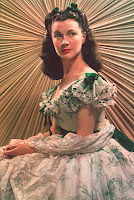
Vivien Leigh.
Now I just have to read the book by Margaret Mitchell.

Favorite Lines:

Scarlett: As God is my witness, as God is my witness they're not going to lick me. I'm going to live through this and when it's all over, I'll never be hungry again. No, nor any of my folk. If I have to lie, steal, cheat or kill. As God is my witness, I'll never be hungry again. 

Rhett Butler: Did you ever think of marrying just for fun? 
Scarlett: Marriage, fun? Fiddle-dee-dee. Fun for men you mean. 

Mammy: Oh now, Miss Scarlett, you come on and eat jess a little, honey! 
Scarlett: No! I'm going to have a good time today, and do my eating at the barbeque. 
Mammy: If you don't care what folks says about dis family I does! I is told ya and told ya that you can always tell a lady by the way she eat in front of folks like a bird. And I ain't aimin' for you to go to Mr. John Wilkenson's and eat like a field hand and gobble like a hog! 
Scarlett: Fiddle-dee-dee! Ashley told me he likes to see a girl with a healthy appetite! 
Mammy: What gentlemen says and what they thinks is two different things, and I ain't noticed Mr. Ashley askin' for to marry you. 
Scarlett: [Turns around slowly to face Mammy then throws her umbrella and stuffs food into her mouth] 
Mammy: Now don't eat too fast. Ain't no need for it come right back up again! 
Scarlett: [With her mouth full] Why does a girl have to be so silly to catch a husband?

Clark Gable (L) and Vivien Leigh.
Rhett Butler: No, I don't think I will kiss you, although you need kissing, badly. That's what's wrong with you. You should be kissed and often, and by someone who knows how. 

Scarlett: [pleads with Rhett as he is about to leave to join the Confederate Army] Oh, Rhett! Please, don't go! You can't leave me! Please! I'll never forgive you! 
Rhett Butler: I'm not asking you to forgive me. I'll never understand or forgive myself. And if a bullet gets me, so help me, I'll laugh at myself for being an idiot. There's one thing I do know... and that is that I love you, Scarlett. In spite of you and me and the whole silly world going to pieces around us, I love you. Because we're alike. Bad lots, both of us. Selfish and shrewd. But able to look things in the eyes as we call them by their right names. 
Scarlett: [struggles] Don't hold me like that! 
Rhett Butler: [holds her tighter] Scarlett! Look at me! I've loved you more than I've ever loved any woman and I've waited for you longer than I've ever waited for any woman. 
[kisses her forhead] 
Scarlett: [turns her face away] Let me alone! 
Rhett Butler: [forces her to look him in the eyes] Here's a soldier of the South who loves you, Scarlett. Wants to feel your arms around him, wants to carry the memory of your kisses into battle with him. Never mind about loving me, you're a woman sending a soldier to his death with a beautiful memory. Scarlett! Kiss me! Kiss me... once... 
[he kisses her]

Clark Gable (L) and Vivien Leigh.
Rhett Butler: You're like the thief who isn't the least bit sorry he stole, but is terribly, terribly sorry he's going to jail. 

Scarlett: But you are a blockade runner. 
Rhett Butler: For profit, and profit only. 
Scarlett: Are you tryin' to tell me you don't believe in the cause? 
Rhett Butler: I believe in Rhett Butler, he's the only cause I know.

Rhett Butler: And those pantalettes, I don't know a woman in Paris who wears pantalettes. 
Scarlett: Oh Rhett, what do they - you shouldn't talk about such things. 
Rhett Butler: You little hypocrite. You don't mind my knowing about them, just my talking about it. 
Scarlett: But really Rhett, I can't go on accepting these gifts although you are AWFULLY kind. 
Rhett Butler: I'm not kind, I'm just tempting you. 
Scarlett: Well if you think I'll marry you just to pay for the bonnet I won't. 
Rhett Butler: Don't flatter yourself. I'm not a marrying man. 

Vivien Leigh.
Scarlett: Ooh, if I just wasn't a lady, WHAT wouldn't I tell that varmint. 

Scarlett: Cathleen, who's that? 
Cathleen Calvert: Who? 
Scarlett: That man looking at us and smiling. The nasty, dark one. 
Cathleen Calvert: My dear, don't you know? That's Rhett Butler. He's from Charleston. He has the most terrible reputation. 
Scarlett: He looks as if... as if he knows what I look like without my shimmy.

Rene Picard: Twenty dollars. Twenty dollars for Miss Maybelle Merriwether. 
Tony Fontaine: Twenty five dollars for Miss Fanny Elsing. 
Dr. Meade: Only twenty five dollars to give? 
Rhett Butler: One hundred and fifty dollars in gold. 
Dr. Meade: For what lady, sir? 
Rhett Butler: For Mrs. Charles Hamilton. 
Dr. Meade: For whom, sir? 
Rhett Butler: Mrs. Charles Hamilton. 
Dr. Meade: Mrs. Hamilton is in mourning, Captain Butler. But I'm sure any of our Atlanta belles would be proud to... 
Rhett Butler: Dr. Meade, I said Mrs. Charles Hamilton. 
Dr. Meade: She will not consider it, sir. 
Scarlett: Oh, yes, I will. 

Title card: There was a land of Cavaliers and Cotton Fields called the Old South... Here in this pretty world Gallantry took its last bow... Here was the last ever to be seen of Knights and their Ladies Fair, of Master and of Slave... Look for it only in books, for it is no more than a dream remembered. A Civilization gone with the wind... 

Vivien Leigh.
Rhett Butler: So, you see I shall have to marry you. 
Scarlett: I've never heard of such bad taste. 
Rhett Butler: Would you be more convinced if I fell to my knees? 
Scarlett: Turn me loose, you varmint, and get out of here! 
Rhett Butler: Forgive me for startling you with the impetuosity of my sentiments, my dear Scarlett. I mean, my dear Mrs. Kennedy. But it cannot have escaped your notice that for some time past the friendship I have felt for you has ripened into a deeper feeling. A feeling more beautiful, more pure, more sacred. Dare I name it? Can it be love? 
Scarlett: Get up off your knees! I don't like your common jokes! 
Rhett Butler: This is an honorable proposal of marriage made at what I consider a most opportune moment. I can't go all my life waiting to catch you between husbands. 
Scarlett: You're coarse, and you're conceited. And I think this conversation has gone far enough.

Scarlett: Rhett, Rhett... Rhett, if you go, where shall I go? What shall I do? 
Rhett Butler: Frankly, my dear, I don't give a damn.

Scarlett: Tara! Home. I'll go home. And I'll think of some way to get him back. After all... tomorrow is another day.